
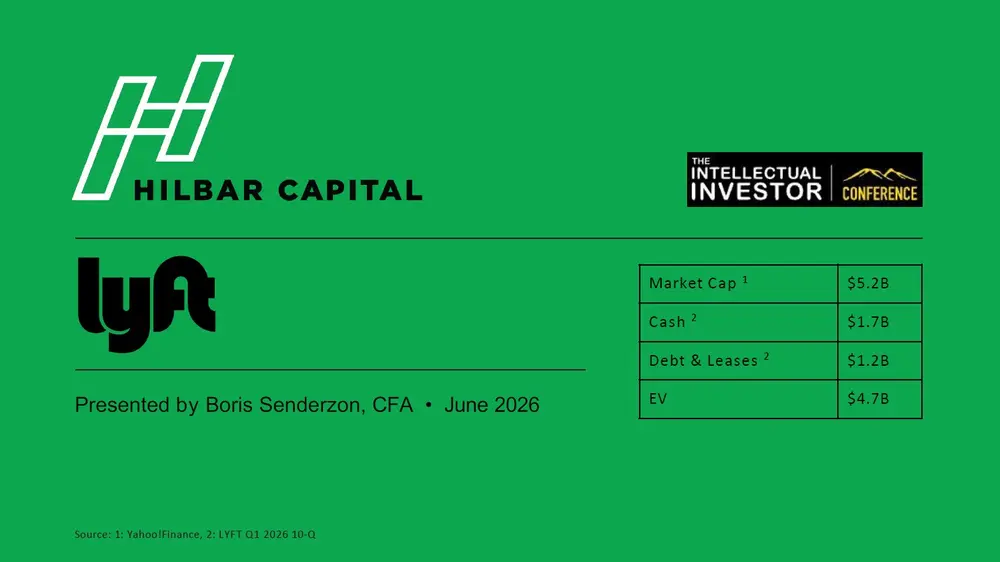
Boris Senderzon, CFA, of Hilbar Capital presents the case for Lyft (and, to a lesser degree, Uber), disclosing that he is long both names and that his wife works at Uber. He frames Lyft as the number-two rideshare player in the US and Canada, with 50 million app users, 29 million active riders, and roughly one billion rides in 2025 — a scale he contrasts with Waymo’s 500,000 rides to argue Lyft is some 40 times larger, and against a total US market of about 160 billion personal trips a year, of which Uber and Lyft combined penetrate only around 4 billion, or 3%. The core of the thesis is a turnaround under CEO David Risher, the former Microsoft and Amazon product executive, whose customer-obsessed culture — he drives for Lyft every six weeks and commutes daily on a Lyft bike — has produced an inflection in EBITDA and free cash flow, sharply reduced stock-based compensation, and pricing that is now competitive with Uber. Senderzon also points to international expansion through the acquisitions of Freenow (eleven European countries including Spain, France, and Germany) and Ola in the UK.
On the autonomous-vehicle question, Senderzon lays out Lyft’s partnership approach — a Waymo tie-up in Nashville and FlexDrive’s 10,000-to-15,000-car fleet for management — and argues the AV threat is tempered by physical infrastructure constraints such as grid upgrades and local opposition, making the rollout slower than expected. He highlights California SB 371, which cuts insurance limits (from $1 million to $60,000 per person and $300,000 per accident); with insurance representing 16% of Lyft revenue, he sees the savings redirected into lower prices to build volume. On valuation, Lyft trades at roughly 5x trailing free cash flow and under 9x 2028 EPS, while Uber commands about 10x bookings and FCF and a 30x market-cap premium that Senderzon contends is too wide; he notes management incentives are heavily weighted to option tranches struck at $30-80 per share, and flags the 2026 World Cup as a tailwind via Freenow in Spain, France, and Germany. In Q&A, he adds that market share has stabilized since Risher took over, with consumer inertia rather than Uber the main challenge; that stock-based compensation of roughly $300 million against $1.1 billion in FCF leaves adjusted free cash flow positive (with no current tax owed given accumulated losses); that insurance costs are per-mile rather than scale-dependent, giving Uber no structural edge; and that a Tesla robotaxi faces unresolved logistics around charging, cleaning, and garage access, making it no near-term threat.
Presentation summary generated by AI